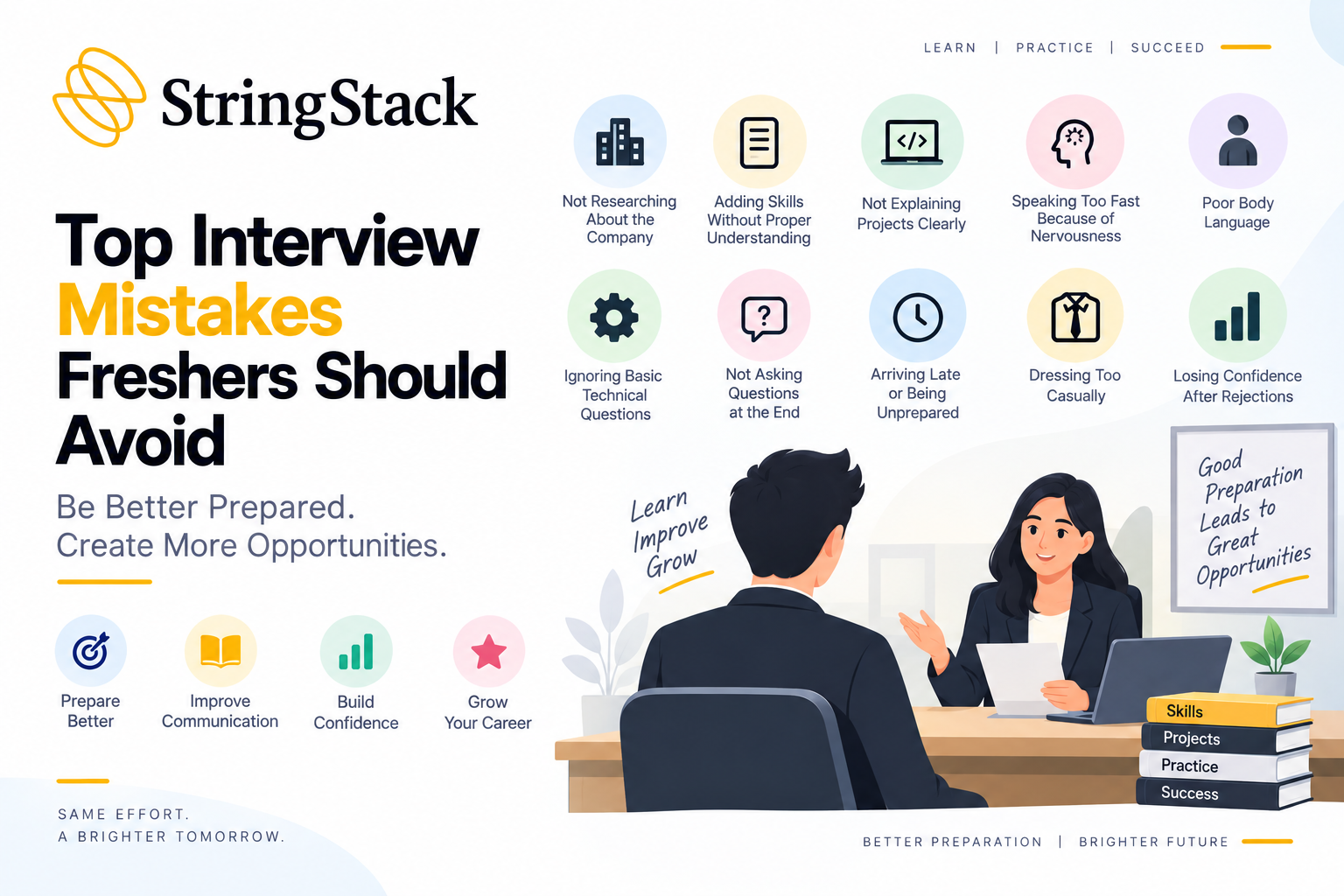
<p>Many students prepare coding skills and projects for interviews, but small mistakes during interviews reduce their chances of getting selected. </p>
<p>Sometimes students know the answers but become nervous or unprepared during the interview. </p>
<p>The good part is that most of these mistakes can be improved with practice. </p>
<p><strong>Not Researching About the Company </strong></p>
<p>One common mistake many freshers make is attending interviews without knowing about the company. </p>
<p>Some students attend interviews without checking:</p>
<ul>
<li>What the company does</li>
<li>Which role they applied for</li>
<li>What skills are needed for the job</li>
<li>What are their Projects</li>
</ul>
<p>This creates a bad impression. </p>
<p>Before attending an interview, spend some time understanding:</p>
<ul>
<li>Company background</li>
<li>Job role</li>
<li>Skills mentioned in the job description</li>
</ul>
<p>Even simple research helps you answer questions better. </p>
<p><strong>Adding Skills Without Proper Understanding </strong></p>
<p>Some students add many technologies in their resume without practicing them properly. </p>
<p>During interviews, interviewers may ask questions from every skill mentioned in the resume. </p>
<p>For example, if you mention:</p>
<ul>
<li>Java</li>
<li>SQL</li>
<li>Spring Boot</li>
<li>APIs</li>
</ul>
<p>you should be comfortable explaining basics and projects related to them. </p>
<p>It is always better to mention skills that you have practiced and understood properly. </p>
<p><strong>Not Explaining Projects Clearly </strong></p>
<p>Interviewers often ask:</p>
<ul>
<li>Tell me about your project</li>
<li>What was your role?</li>
<li>Which technologies did you use?</li>
<li>What problem does your project solve?</li>
</ul>
<p>Many students become confused while answering these questions. </p>
<p>Before attending interviews, understand your projects clearly:</p>
<ul>
<li>What the project does</li>
<li>Why you built it</li>
<li>Which technologies were used</li>
<li>What features you worked on</li>
</ul>
<p>Even a simple project creates a good impression if you explain it properly. </p>
<p><strong>Speaking Too Fast Because of Nervousness </strong></p>
<p>Many freshers become nervous during interviews. </p>
<p>Because of nervousness, students may:</p>
<ul>
<li>Speak too fast</li>
<li>Forget answers</li>
<li>Become blank while answering questions</li>
</ul>
<p>To improve:</p>
<ul>
<li>Practice speaking slowly</li>
<li>Attend mock interviews</li>
<li>Explain concepts aloud while practicing</li>
<li>Take a few seconds before answering questions</li>
</ul>
<p>Confidence improves with regular practice. </p>
<p><strong>Poor Body Language During Interviews </strong></p>
<p>Body language also matters during interviews. </p>
<p>Some common mistakes include:</p>
<ul>
<li>Looking down while speaking</li>
<li>Sitting carelessly</li>
<li>Avoiding eye contact</li>
<li>Looking distracted during online interviews</li>
</ul>
<p>Simple improvements can create a better impression:</p>
<ul>
<li>Sit properly</li>
<li>Maintain eye contact</li>
<li>Listen carefully</li>
<li>Stay focused during the interview</li>
</ul>
<p><strong>Ignoring Basic Technical Questions </strong></p>
<p>Some students prepare only advanced topics and ignore basics. </p>
<p>But many companies ask questions from:</p>
<ul>
<li>Programming basics</li>
<li>OOP concepts</li>
<li>Arrays and Strings</li>
<li>SQL basics</li>
<li>Resume projects</li>
</ul>
<p>Revise basics regularly before interviews. </p>
<p>In many interviews, clear understanding of basics creates a stronger impression than memorizing advanced topics. </p>
<p><strong>Not Asking Questions at the End </strong></p>
<p>At the end of interviews, interviewers often ask: </p>
<p>“Do you have any questions?” </p>
<p>Many students simply say “No.” </p>
<p>Instead, prepare a few simple questions before the interview. </p>
<p>For example:</p>
<ul>
<li>What technologies does the team work on?</li>
<li>What kind of work do freshers usually get?</li>
<li>How does the company support learning for freshers?</li>
</ul>
<p>This shows interest and preparation.</p>
<p><strong>Arriving Late or Being Unprepared </strong></p>
<p>Some students join interviews late because of:</p>
<ul>
<li>Traffic</li>
<li>Internet problems</li>
<li>Poor planning</li>
</ul>
<p>Others forget:</p>
<ul>
<li>Resume copies</li>
<li>Required documents</li>
<li>Proper setup for online interviews</li>
</ul>
<p>Before the interview:</p>
<ul>
<li>Keep your resume ready</li>
<li>Check internet and audio</li>
<li>Join a few minutes early</li>
<li>Sit in a quiet place for online interviews</li>
</ul>
<p>Small preparation helps reduce stress. </p>
<p><strong>Dressing Too Casually </strong></p>
<p>You do not need expensive clothes for interviews. </p>
<p>But dressing neatly creates a professional impression. </p>
<p>For interviews:</p>
<ul>
<li>Wear simple formal clothes</li>
<li>Avoid very casual outfits</li>
<li>Maintain basic grooming</li>
</ul>
<p>Neat appearance shows seriousness towards the opportunity. </p>
<p><strong>Losing Confidence After Rejections </strong></p>
<p>Many freshers face rejections in the beginning.</p>
<p>This is normal.</p>
<p>One rejection does not decide your future.</p>
<p>Every interview teaches something:</p>
<ul>
<li>Which topics need improvement</li>
<li>How to answer questions better</li>
<li>How interviews work</li>
</ul>
<p>Instead of stopping after rejection:</p>
<ul>
<li>Continue learning</li>
<li>Keep practicing</li>
<li>Attend more interviews</li>
</ul>
<p>Confidence grows slowly with experience.</p>
<p><strong>Simple Ways to Prepare Better </strong></p>
<table cellspacing="0" style="border-collapse:collapse; width:624px">
<tbody>
<tr>
<td style="border-bottom:1px solid #000000; border-left:1px solid #000000; border-right:1px solid #000000; border-top:1px solid #000000; vertical-align:top">
<p><strong>Area</strong></p>
</td>
<td style="border-bottom:1px solid #000000; border-left:1px solid #000000; border-right:1px solid #000000; border-top:1px solid #000000; vertical-align:top">
<p><strong>What You Can Do </strong></p>
</td>
</tr>
<tr>
<td style="border-bottom:1px solid #000000; border-left:1px solid #000000; border-right:1px solid #000000; border-top:1px solid #000000; vertical-align:top">
<p>Company Research </p>
</td>
<td style="border-bottom:1px solid #000000; border-left:1px solid #000000; border-right:1px solid #000000; border-top:1px solid #000000; vertical-align:top">
<p>Read about company and job role </p>
</td>
</tr>
<tr>
<td style="border-bottom:1px solid #000000; border-left:1px solid #000000; border-right:1px solid #000000; border-top:1px solid #000000; vertical-align:top">
<p>Technical Preparation </p>
</td>
<td style="border-bottom:1px solid #000000; border-left:1px solid #000000; border-right:1px solid #000000; border-top:1px solid #000000; vertical-align:top">
<p>Revise basics and projects </p>
</td>
</tr>
<tr>
<td style="border-bottom:1px solid #000000; border-left:1px solid #000000; border-right:1px solid #000000; border-top:1px solid #000000; vertical-align:top">
<p>Communication<strong> </strong></p>
</td>
<td style="border-bottom:1px solid #000000; border-left:1px solid #000000; border-right:1px solid #000000; border-top:1px solid #000000; vertical-align:top">
<p>Practice speaking clearly<strong> </strong></p>
</td>
</tr>
<tr>
<td style="border-bottom:1px solid #000000; border-left:1px solid #000000; border-right:1px solid #000000; border-top:1px solid #000000; vertical-align:top">
<p>Mock Interviews </p>
</td>
<td style="border-bottom:1px solid #000000; border-left:1px solid #000000; border-right:1px solid #000000; border-top:1px solid #000000; vertical-align:top">
<p>Practice with friends </p>
</td>
</tr>
<tr>
<td style="border-bottom:1px solid #000000; border-left:1px solid #000000; border-right:1px solid #000000; border-top:1px solid #000000; vertical-align:top">
<p>Resume Preparation </p>
</td>
<td style="border-bottom:1px solid #000000; border-left:1px solid #000000; border-right:1px solid #000000; border-top:1px solid #000000; vertical-align:top">
<p>Keep resume simple and clear and ATS friendly</p>
</td>
</tr>
<tr>
<td style="border-bottom:1px solid #000000; border-left:1px solid #000000; border-right:1px solid #000000; border-top:1px solid #000000; vertical-align:top">
<p>Online Interviews </p>
</td>
<td style="border-bottom:1px solid #000000; border-left:1px solid #000000; border-right:1px solid #000000; border-top:1px solid #000000; vertical-align:top">
<p>Check internet and audio before joining </p>
</td>
</tr>
</tbody>
</table>
<p><strong>Conclusion</strong></p>
<p>Interviews may feel difficult in the beginning, especially for freshers attending them for the first time.</p>
<p>Making mistakes is normal, but learning from them is important.</p>
<p>Focus on:</p>
<ul>
<li>Strong basics</li>
<li>Clear communication</li>
<li>Small projects</li>
<li>Regular practice</li>
</ul>
<p>Keep improving step by step. With practice and consistency, confidence improves over time.</p>
Top Mistakes Freshers Commit During an Interview